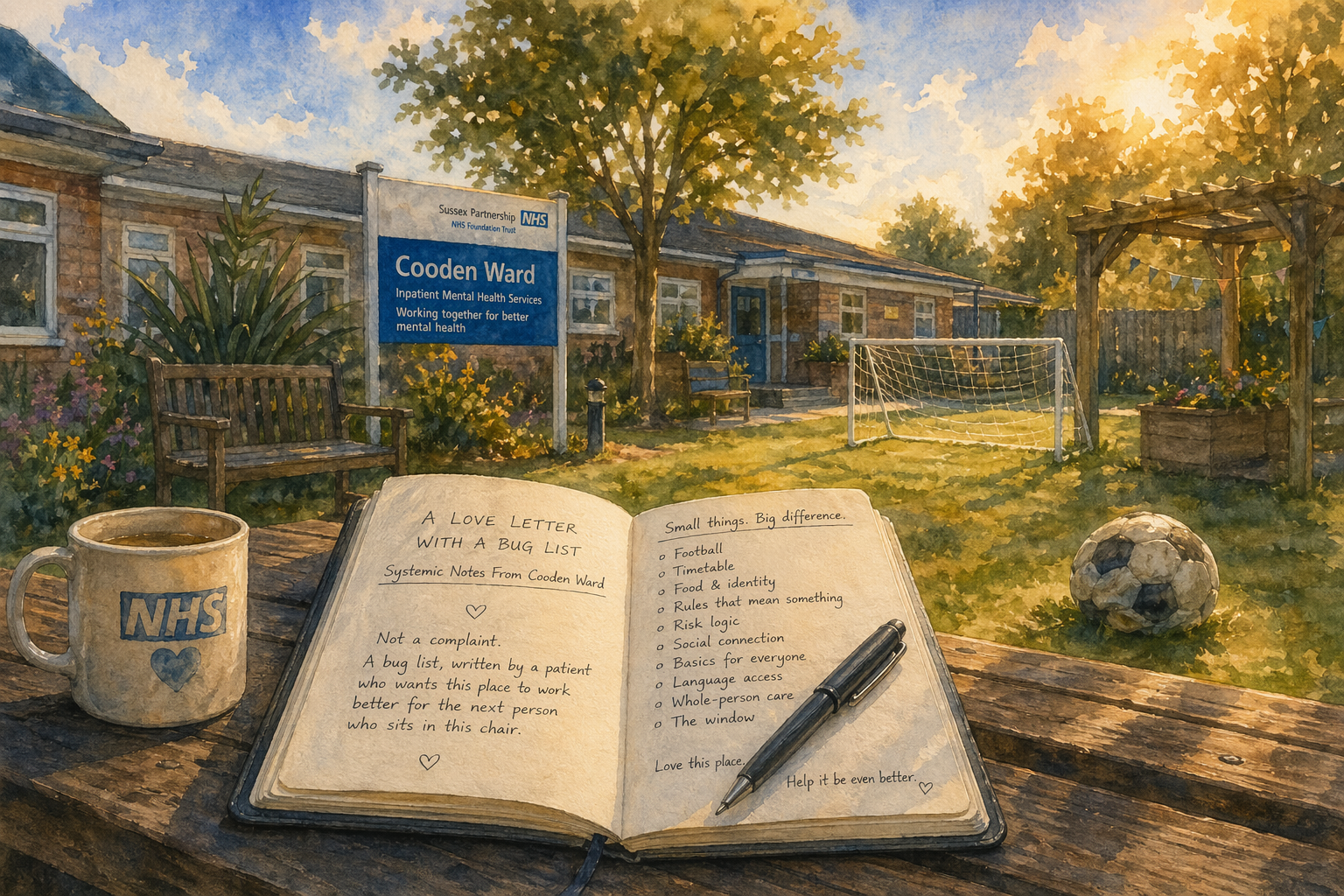
Written from the garden of Cooden Ward, mid-afternoon, feeling okay. Not an accusation. Not a rant. A letter.
The voice note this came from
Before the cleaned-up version below, here is the raw thing — the voice note I recorded in the garden. Uncut, a bit rambling, with the bird noise in the background and a couple of sharp edges that I’ve since sanded off. I leave it here because the essay is downstream of this, and because anyone wondering “is this what a patient actually sounds like when they’re trying to think about the ward that’s holding them” should hear the unedited version too.
The written post below is the calmer, kinder, more specific version of the same list. Both are me. One is the first draft in the garden, the other is the one I’d hand to the ward manager.
Who this post is for
Cooden Ward in Bexhill is one of Sussex Partnership NHS Foundation Trust’s inpatient psychiatric wards. I’ve been an inpatient here for about four weeks. I arrived detained. I’m now an informal patient — I can walk out the front door any time I like, and a couple of days ago I did exactly that, and went home to see my dogs. I came back. I wrote about why in another post.
I’m staying a little longer. And because I’m staying, I want to leave the place a tiny bit better than I found it.
So this is for three groups of people, in order:
- The staff and managers of Cooden Ward. You are, genuinely, trying. Some of you have been extraordinary with me. I mean that. Please read this as feedback from someone who wants the ward to succeed.
- Other patients who will sit in this chair after me. I want to name the things that are hard, because naming them is the first step to fixing them, and because when you’re in crisis the worst thing is thinking “it’s just me.”
- Anyone in NHS mental health commissioning, CQC, or Healthwatch who reads patient blogs as part of their work. Hello. These are the things that show up when you live here, not when you visit.
I’m going to try to be specific. Vague complaints are useless. Specific ones are a roadmap.
The frame: small things compound
Before the list, one observation.
Nothing on this list is a scandal. There is no single item here that, on its own, makes this a bad ward. The staff are not cruel. The food is not inedible. The building is not falling down. If a journalist walked through for an afternoon they would, honestly, find it fine.
But I don’t live here for an afternoon. I live here for a month. And when you live somewhere for a month, small frictions compound. A slightly-flat football plus a not-quite-updated timetable plus a rule that isn’t enforced plus a rule that’s enforced differently for different people — each one is a shrug. Together, they are the texture of the place. And the texture of a psychiatric ward is, itself, a therapeutic intervention. Or an anti-therapeutic one.
So: in the spirit of “small things compound,” here are the small things.
1. The things we’re supposed to do for fun
There is a football in the garden. It is flat. There is another one. It is also flat. There is goalkeeping equipment, boxed, that nobody has assembled and, when I asked, nobody quite knew what was in the box.
In the same month that this is true, the gardeners came and did the garden. I am sure they did their professional job. The garden looks, to my untrained eye, almost exactly the way it looked before they arrived. The grass is possibly a little shorter.
I am not saying don’t pay the gardeners. I am saying: the ratio of money spent on things that look like care to money spent on things that are care is off. A pump for a football costs £4. A new ball costs £10. An afternoon of assembling the goalkeeping kit, so that the five of us in the garden right now could actually play a game together, costs a staff member thirty minutes.
Football in a garden with other patients is not a luxury. For a lot of the men on this ward, it is the only form of group therapy they will ever engage with voluntarily. It is the thing that, for twenty minutes, lets someone who cannot talk about their feelings be on a team with other people who can’t either. That is not nothing. That is, arguably, the most important thing that happens here.
The ratio is fixable. That’s the point.
2. The timetable
There is an activities timetable on the wall. It tells us what is happening this week.
The version on the wall, this week, is last week’s.
On Sunday, there is no timetable at all for the coming week, so you go to bed on Sunday night not knowing whether anything is on on Monday. For someone with ADHD — which is half the men on this ward, statistically — not being able to see the shape of the next seven days is its own kind of distressing. The calendar is a regulatory tool. Take it away and you’ve removed a scaffold.
The fix is laminated paper and a whiteboard pen. It’s not a budget problem. It’s a habit problem. Someone, on Friday, needs to own “the timetable for next week is up before I go home.” That’s it. That’s the whole fix.
3. The food, and what it’s quietly doing
I arrived on this ward as a vegetarian. A real one, for years. Not an identity, a practice.
The food here is not always what the menu says it is. I have eaten a “cheese sandwich” that had ham in it. I did not notice until I was halfway through. The staff were not being malicious — they were busy, a tray was mis-labelled, nobody checked.
I want to be careful here, because this is the thing I feel most strongly about, and feelings can make essays worse. So let me just say the structural observation:
When food is the only thing in your day that is reliably yours, getting it wrong is not a catering error. It is an identity erosion. I came in as a vegetarian. Four weeks later I am a man who has eaten meat most weeks because checking every sandwich every time is more executive function than I have on my worst days, and my worst days are why I’m here.
Multiply this out. The person across the corridor is Muslim. The person next to him is diabetic. The person next to him has an eating disorder. Food errors on a psychiatric ward aren’t like food errors in a canteen. They land on people whose relationship to food is already the thing they’re in hospital for.
Fix: a second person checks the tray labels against the patient list before the trolley leaves the kitchen. Thirty seconds. Enormous difference.
4. The rules we don’t actually enforce
There is a rule that says no smoking in the rooms.
Almost every smoker on this ward smokes in their room. I have, on occasion, been one of them. Vapes, mostly. A few cigarettes. The fire alarm has not gone off, which is lucky, because it would.
There is a rule that says no lighters on the ward. There are, by my informal count, at least seventeen lighters on the ward right now. The rule is so comprehensively not enforced that patients openly discuss whose lighter is whose.
I do not want a body search. I am not asking for the rules to get harsher. I am pointing at something quieter and more corrosive:
A rule that exists but isn’t enforced teaches everyone on the ward that the rules don’t mean anything. And on a psychiatric ward, where a lot of us are here because the rules in our own heads have stopped meaning anything, that’s a weird lesson to be teaching.
Pick one: enforce the rule, or remove it and build a proper outdoor smoking area with a supervised lighter. Both of those are fine. The current state — “the rule exists but everyone ignores it” — is the only option that is not fine.
5. The contraband logic doesn’t quite add up
I cannot take a spoon to my room.
I can take a phone charger with a cable. I have a belt. I have a laptop charger. My door has a handle. The window opens.
I understand the principle the spoon-rule is trying to instantiate. I honestly do. I just want to name that the set of objects currently classified as dangerous, and the set of objects actually available in any given room, don’t form a coherent risk model. A patient in genuine crisis can tell you this in thirty seconds. The rule feels designed to demonstrate that a risk assessment has happened, rather than to actually reduce risk.
If a real risk assessment says the charger cable has to go too, fine — I’ll live. If it says the spoon is actually fine, also fine. But the current middle state isn’t safety, it’s theatre, and theatre is insulting to people whose lives the risk assessment is allegedly protecting.
6. Team-building, but only if your friends are already patients
I would like, one afternoon, to invite a friend of mine to the garden to play football with me and a couple of the other lads. Not to visit me in a visiting room. Not for a formal visit. Just — out here, kicking a ball, an hour, the way any other human being in England can.
The answer I have been given is no, and that I should go alone.
I don’t want to go alone. Recovery is social. The ward knows this — it’s why “group activity” is on the timetable. But the ward’s definition of “social” is bounded by the ward. The people I can socialise with are other unwell people. The people who are well in my life — who could model wellness for me, who could remind me who I was before I got here — those people are kept on the other side of a door.
I am not asking for an open visiting policy. I am asking: is there, anywhere in the week, a structured way for an informal patient to bring one vetted outside person into the garden for an hour? If there isn’t, there should be. Other wards have figured this out. It’s not a new problem.
7. If you arrive with nothing, you stay with nothing
When I arrived, I had no money on me, no change of clothes, no nail clippers, no deodorant, no phone charger. This is normal — people admitted in crisis usually don’t pack a bag.
The ward does not have a stock of any of these things.
For the first days of my admission, I had access to exactly what the person who found me had in her handbag. Everyone else on the ward with money — or with a family member willing to drive supplies in — was living in a different hospital than I was. The gap between the two hospitals is money, and nothing else.
I have been the well-resourced patient before. I am the well-resourced patient now. I want to name, from inside, that this ward has two tiers of experience, and the tier you end up in is decided in the first 48 hours based on whether someone knows you’re here and can bring you a charger. A stocked cupboard of basics — clippers, deodorant, a change of shorts, a £5 phone charger — costs the ward almost nothing and closes the biggest equity gap on this unit.
8. The language gap is a safeguarding problem
There is a patient on this ward who does not speak English. I will call him Elvis, because that’s roughly the vibe.
Elvis has been here longer than I have. In that time, as far as I have been able to observe, no interpreter has been provided. Not in person, not on a phone, not once.
I asked for a translator on my first day. I did not need one — I speak English — I asked because Elvis needed one, and I could tell nobody had thought to ask on his behalf. I was told, politely, that it was in hand. Three weeks later, it is not in hand.
This is the item on this list I feel most strongly about. Everything else on this list is texture. This one is a safeguarding failure. A patient who cannot communicate with clinicians cannot give informed consent. Cannot describe symptoms. Cannot disagree with a care plan. Cannot ask for help.
NHS England has a Language Line contract. It works over a phone. Any ward can use it. It takes four minutes. I have watched an entire clinical conversation with Elvis happen in mime. This is not 2006. We can do better than mime.
9. The things the ward is not checking for
I have a mole on my leg. It has changed shape in the last six months. That is the thing the NHS tells you, in posters at every bus stop, to go to your GP about immediately. I asked, on admission, whether a dermatologist could look at it. I asked again in week two. I have not, at week four, had anyone look at it.
I am going to be fine. The mole is probably nothing. But the structural point is:
The mental health ward treats the mental half of the patient and not the physical half. The patient is one body. The split is institutional, not clinical. In the time I’ve been here, no one has taken my blood pressure outside of medication observations, no one has asked about the mole, no one has asked about the lump under my jaw I’ve had for a year. These are ordinary primary-care things that a GP would notice in five minutes. On the ward, they vanish, because the ward has decided that its job is a narrow one.
If I died of something unrelated to my mental health while I was here, it would be recorded as a death-in-care and someone would write a report about it. The report would conclude that the ward needed to widen its definition of care. I would rather we widened the definition of care now, without the report.
10. The window
The rule is that between 7pm and 7am I have to hand in my laptop.
I wrote about this in the Reunion post, so I won’t repeat the whole thing. Just the short version:
My creative window is 3am to 7am. That is the ADHD. That is also how I build the thing that pays my rent, feeds my dogs, and — not incidentally — is part of why I’m still here rather than not here. The ward’s rule closes the window that is, for me and for a non-trivial number of other ADHD patients, the only window that opens.
I am not asking for the rule to be abolished. I am asking whether there is a version of this rule that says “if you have demonstrated over two weeks that you can be trusted with a laptop at night, your laptop stays with you, reviewed weekly.” That is how every other reasonable institution handles graded trust. The ward does not have to reinvent it.
What I want to say at the end
I have been, at moments in the last four weeks, in real crisis. Staff on this ward — specific, named humans — have been the thing between me and a worse outcome. I want to say that clearly before I say the rest, because it is true, and because if you only read one paragraph of this essay I want it to be this one.
Everything on the list above is fixable. Not by a reorganisation. Not by more funding, even. By attention. By the ward taking its own stated rules seriously, by closing the gap between the hospital the rich patient is in and the one the broke patient is in, by remembering that the body is attached to the brain, by treating language access as a safeguarding issue, by giving the ADHD guys their laptops back at 3am.
I am going to hand this post to the ward manager before I am discharged. Not as a grievance. As a gift. Here is the list of things I noticed, written by someone who is on your side.
If you are a patient reading this who is about to be admitted somewhere like Cooden Ward, I want to say the other thing too: none of this means you shouldn’t come in. Come in. The roof is a better roof than no roof. The texture issues I’ve listed are real, but the ward is still, on almost every night I’ve been here, the safer place for the person who needs it. Walk in the door. Ask for the things on this list. If you ask, maybe by the time you leave, some of them will be fixed.
And if you are one of the people I have played football with in this garden, with the flat ball — when I get out, I’m bringing a proper one. That’s a promise.
Written as a patient. Intended in good faith. Corrections and disagreements welcome at zoltan@spike.land — especially if you are a clinician or a manager and I have got something wrong. I’d rather be corrected than right.